The Audit Shield System
Is Your Shop Ready for a Surprise DOT Audit?
Stop Relying on Your Lead Mechanic’s Memory. Start Using a System That Ensures Compliance.
Most Transportation Directors live in fear of the “Surprise Terminal Inspection.” You know your team works hard, but if an inspector walks in today, could you prove it?
If your maintenance records are scattered in grease-stained folders or stuck in a “Hero” mechanic’s head, you are one missing signature away from a Critical Violation or a grounded fleet.
The Problem: The “Hero” Dependency
When only one person knows how your shop is organized, your district is at risk. If that person is out sick or leaves the district, your compliance evaporates.
The Solution: The “Audit Shield” Vehicle Binder System
I’ve spent 25 years in the trenches managing multi-million dollar fleets. I’ve survived the audits you’re worried about. I built this kit to give you the exact Standard Operating Procedures (SOPs) I used to turn chaotic shops into audit-proof operations.
What’s Inside the Kit ($47 One-Time Purchase):
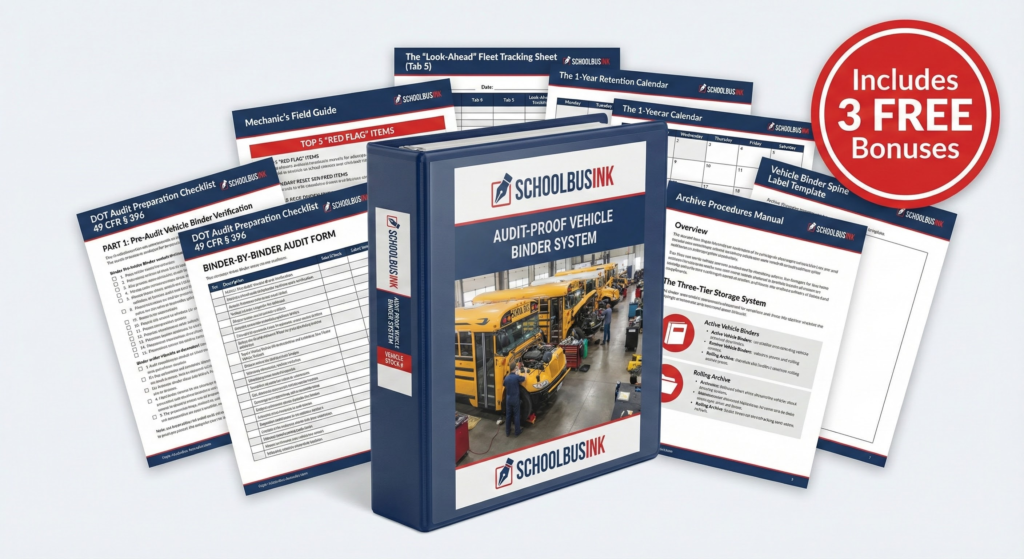
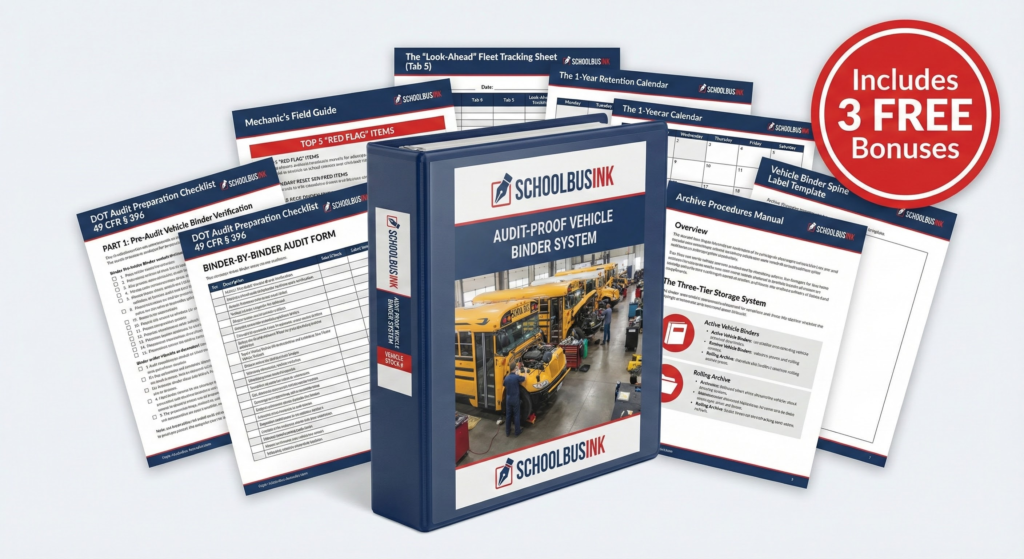
- 🛡️ The 5-Tab Binder SOP: The blueprint for organizing every vehicle file so an inspector can find what they need in 5 seconds.
- 📋 Master DOT Preparation Checklist: A 7-page “Final Exam” for your shop. Find your own mistakes before the State Police do.
- 📅 The “Look-Ahead” Tracking Sheet: A Tab 5 essential that ensures 90-day and annual inspections never catch you by surprise again.
- 🚛 Mechanic’s Field Guide (Bonus): A “Traffic Light” system for your shop floor to ensure every DVIR loop is closed and every wheel re-torque is documented.
- 📂 Archive Procedures Manual (Bonus): Stop the file cabinet overflow. Know exactly what to keep, where to store it, and when it’s legally safe to shred.
- 🏷️ Binder Spine Templates (Bonus): Professional labels to move your shop from “shoebox filing” to a professional command center.
DOT Vehicle Maintenance Compliance for School Districts
Are school districts actually subject to DOT audits?
While exempt from interstate commerce, they are never exempt from vehicle safety standards under Part 396.
Regulatory Authority & Requirements
“Our district is a government entity. Are we actually subject to DOT audits?”
Yes. While school districts are exempt from certain interstate commerce regulations (such as hours of service rules), you are never exempt from vehicle safety and maintenance standards. Under 49 CFR § 396, every motor carrier—including school districts—must maintain a systematic maintenance program for vehicles designed to transport 16 or more passengers (including the driver).
State Police or DOT inspectors conduct “Terminal Inspections” specifically to review your vehicle maintenance files. These inspections can be conducted without advance notice, making continuous compliance essential.
“What’s the difference between the Annual Inspection and the 90-Day Inspection?”
The Annual Inspection (49 CFR § 396.17) is a comprehensive safety inspection performed once every 12 months by a qualified inspector. The inspection report must be retained for 14 months and a copy must be carried on the vehicle.
The 90-Day Inspection is an internal periodic inspection of safety-critical equipment required every 90 days, with records kept in the vehicle binder. Both are mandatory—the 90-day inspection does not replace the annual inspection; they serve different purposes and both must be maintained.
“Who qualifies as an ‘inspector’ for these maintenance records?”
For annual inspections, the inspector must meet the qualifications outlined in 49 CFR § 396.19—this includes having knowledge, training, experience, or certification in vehicle maintenance and safety inspection procedures.
For daily DVIRs, the driver performs the inspection as part of their pre-trip and post-trip duties.
For 90-day inspections, your shop personnel can perform them if they meet the qualified inspector standards. Keep documentation of your inspectors’ qualifications on file—auditors will ask for it during inspections.
Common Compliance Issues
“What is the biggest mistake districts make during an inspection?”
Failure to “close the loop” on driver reports. Inspectors specifically look for Driver Vehicle Inspection Reports (DVIRs) stapled to the corresponding Work Orders to prove that reported defects were actually addressed. Under 49 CFR § 396.11, DVIRs must be retained for 90 days.
Missing signatures, gaps in the 90-day DVIR records, or defects without certification that they were either “repaired” or deemed “no repair necessary” are leading causes of audit failures. The second most common mistake is operating vehicles beyond their 90-day inspection window.
“Our drivers don’t always complete DVIRs. Is this really that important?”
Critical. 49 CFR § 396.11 requires drivers to complete a DVIR at the end of each day the vehicle is operated. Even if “no defects” are found, the form must be completed and signed. Missing DVIRs are one of the top violations cited during DOT inspections.
More importantly, if a defect causes an incident and there’s no DVIR trail documenting inspections and repairs, your liability exposure increases dramatically. Make DVIR completion a non-negotiable part of your drivers’ end-of-route procedures.
“Why do we need to re-torque wheels after removal?”
Federal regulations and industry best practices require wheel re-torquing after any wheel removal to prevent catastrophic wheel-off incidents. The initial torque can settle after 50-100 miles of operation, potentially loosening wheel fasteners.
Document both the initial torque specification and the 50-100 mile re-check on your work order. This is a high-liability item—wheel separations cause serious crashes and attract intense DOT scrutiny and potential lawsuits.
Record-Keeping & Systems
“How long do we really need to keep these records?”
Federal law is strict: Maintenance records must be retained where the vehicle is housed for one year, and for six months after a vehicle leaves your control (sold or retired).
If you dispose of a bus and discard the maintenance file immediately, you are technically out of compliance for the next six months. This retention requirement is specified in 49 CFR § 396.3(b).
“Can’t I just use my fleet software for this?”
Electronic records are legally acceptable under 49 CFR § 396.3, but they must be immediately accessible during an inspection. Software is excellent for data management, but when an inspector walks into your shop, they expect instant access to records.
Many inspectors prefer physical binders because they can review them while walking the shop floor without requiring computer access. Additionally, software doesn’t help if the system is down, internet is unavailable, or you can’t locate the right records quickly under pressure.
This Binder System ensures that even if your software is down or your key maintenance personnel are unavailable, any staff member can hand the inspector a clean, organized binder that proves compliance in seconds.
Consequences & Enforcement
“What happens if we fail a DOT inspection?”
Consequences can be severe and include:
1. Out-of-Service Orders: Individual vehicles being placed out of service until violations are corrected, potentially disrupting routes.
2. Monetary Fines: Penalties ranging from $100 to $16,000+ per violation, depending on severity.
3. Increased Scrutiny: Follow-up inspections and closer monitoring of your operations.
4. SMS Score Impact: Negative impact on your FMCSA Safety Measurement System (SMS) scores, which are publicly available.
5. Liability Exposure: Most critically, if an inadequately maintained vehicle is involved in an incident, your liability exposure and potential for lawsuits increases significantly.
“Can we get a warning first, or do inspectors issue fines immediately?”
It depends on the violation severity. Minor administrative issues (such as incomplete paperwork with no safety implications) might receive a corrective action notice giving you time to remedy the situation.
However, safety-critical violations—such as expired annual inspections, operating with unrepaired safety defects, or missing qualified inspector documentation—typically result in immediate out-of-service orders and potential fines.There is no “grace period” for federal regulations. Compliance is expected at all times. The best strategy is proactive compliance rather than hoping for leniency after violations are